Electric Hypercar Concept Design
Students
Bror Alwin
Supervisors
Brita Fladvad Nielsen
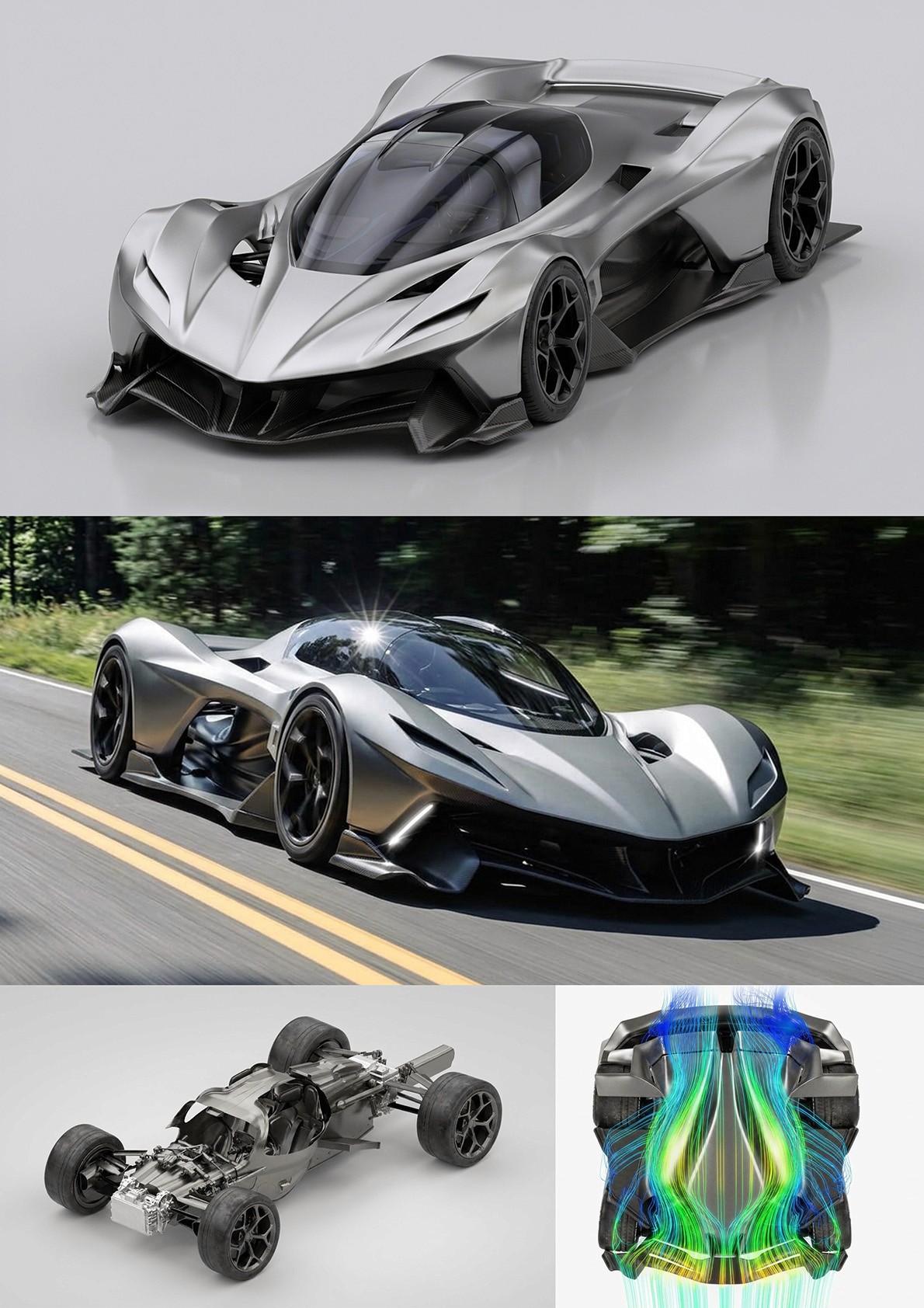
This project explores the design of “Max-Q”, an electric hypercar concept built around the unique possibilities of battery-electric architecture. The goal was to investigate how an electric car can become a serious and emotionally engaging performance object, not by copying combustion-engine hypercars, but by using the strengths of electric technology in its own way.
The design focuses on the relationship between aesthetics, vehicle layout, aerodynamics, and performance. Because an electric drivetrain can be packaged differently from a traditional combustion engine, the concept creates more freedom for airflow through and under the car. This makes it possible to develop large underbody air tunnels, deep side channels, a powerful rear diffuser opening, and cleanly integrated cooling solutions. The vehicle is therefore developed as a complete system, not only as an exterior shape.
A major part of the project was aerodynamic development through aerodynamic simulations (CFD). Through many design iterations, the concept was tested and refined to improve downforce, air resistance, airflow quality, and balance. The final version produces 1031 kgf of downforce at 150 mph. In simple terms, the air pushes the car downward with a force equivalent to just over one tonne of weight at high speed, helping it generate more grip for high-speed cornering. At the same time, the concept maintains an aerodynamic efficiency of 4.22:1, meaning it produces more than four times as much downforce as air resistance. The design packages a four-wheel-drive electric drivetrain based on real-world components capable of 1914 hp.
The process combines traditional industrial design methods with modern digital and technical tools. This includes research, benchmarking, digital sketching, architecture concept development, CAD modelling, CFD simulation, aerodynamic refinement, and 3D visualization.