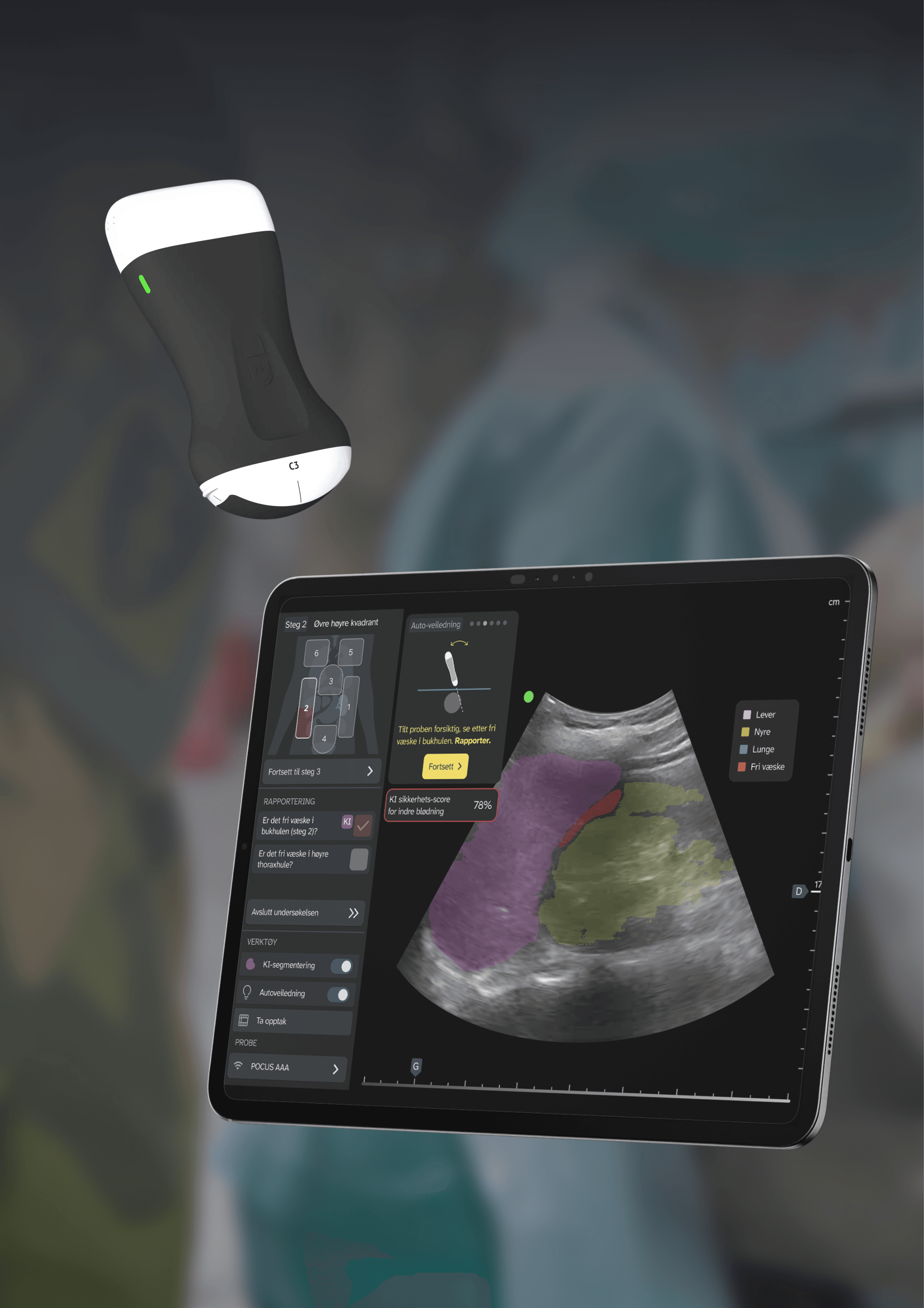
Human-centred design of an AI-guided point-of-care ultrasound interface for combat casualty care
Students
Catherine Coates Tvete
Frida Granum Staxrud
Supervisors
Ashis Jalote Parmar
Cecilie Våpenstad
This master's thesis explores the design of a human-centred, AI-assisted user interface for point-of-care ultrasound (POCUS), to support the performance and interpretation of the eFAST examination (Extended Focused Assessment with Sonography in Trauma), which identifies internal bleeding and pneumothorax. In combat casualty care (CCC), this is critical, as non-compressible torso haemorrhage remains a leading cause of preventable death before surgical intervention. The goal is to enable military healthcare personnel, who are novices to ultrasound, to perform and interpret this life-saving diagnostic in crisis and war situations. The project was conducted in collaboration with SINTEF as part of the AI POCUS CCC project. It investigates how human-centred design methodology can be applied to create an intuitive and reliable interface for AI-guided ultrasound, while maintaining transparency, feedback, and error tolerance in AI-supported decision-making.
The findings of this master's thesis indicate that well-designed AI guidance may reduce cognitive load and structure task execution, enabling novice users to perform complex diagnostic procedures more effectively. Additionally, the study highlights the importance of designing for transparency and user control to foster trust and ethical accountability in AI-assisted healthcare systems. This work contributes to exploring how human-centred design can inform the development of AI-assisted diagnostic tools, with the aim of strengthening military medical capabilities and supporting rapid and informed decision-making in crisis and war situations.